
“A Deal Meant to Transform Guyana — That Transformed Everyone But Guyana”
It was hailed as Guyana’s great energy awakening, a geopolitical handshake between Georgetown and Washington that promised power, prosperity, and progress. But as the Wales Gas-to-Energy project unravels, its legacy may be less “breakthrough” and more breakdown — the straw that broke the pony’s back.
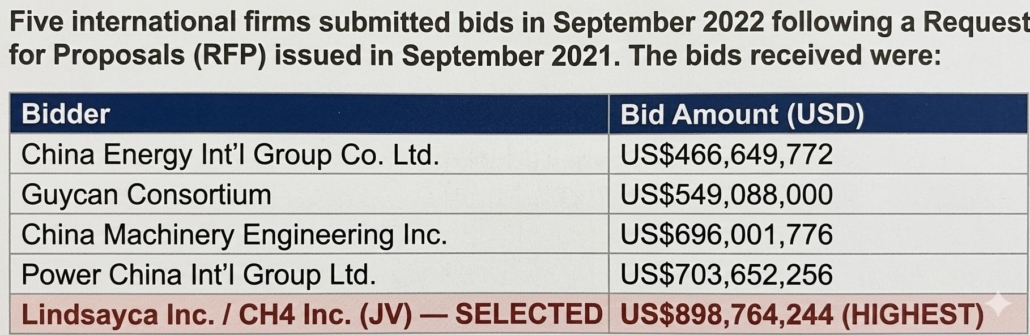
When the Government of Guyana awarded the US $759 million bid (financed at roughly US $587 million) to the Lindsayca–CH4 consortium, it bypassed four lower proposals and catapulted the U.S. Export–Import Bank into Guyana’s largest sovereign energy financing ever. The narrative was sold with polished conviction: America would outperform China, ushering transparency, efficiency, and ethical business practice where Beijing’s shadow allegedly fell.
Yet in retrospect, the moral high ground looks suspiciously like a hill of sand. The U.S. “better partner” promise wasn’t born of goodwill — it was guerrilla economics, an ideological wage to usurp Chinese influence under the guise of partnership. In private, it was celebrated in Washington as a geopolitical victory, complete with claims of 1,500 new American jobs, U.S.-made turbines, and robust returns for investors. But beneath the gloss lay a darker calculus: advancement not of Guyana’s development, but of America’s strategic footprint, dressed up as benevolence.
The irony, of course, is that everyone was playing the same game — only from opposite ends of the table. U.S. actors pushed business policy as foreign diplomacy, while Guyanese powerbrokers treated diplomacy as private industry. The match was perfect; the motivations were identical; only the rhetoric differed.
The Price of Patronage
The Wales deal, lacking meaningful feasibility studies, was engineered for speed, not substance. EXIM Bank signed with eyes open — a move that defied its own internal protocols on project viability assessment. By the time signatures dried and champagne corks popped, the structure was already sinking under the weight of imaginative accounting and inflated valuation.
The result: a project that cost more, promised more, and delivered less. The mantra of “higher price equals superior performance” collapsed spectacularly; Guyanese contractors and political interlocutors enriched themselves in the short term while the nation’s long-term prospects dimmed.
In the local pipeline, Bharat Jagdeo’s fingerprints are everywhere — the familiar strategy of grand design meets selective execution. His political formula remains constant: big ideas, bold deliveries, and bigger beneficiaries. The Wales Gas-to-Energy project fits snugly into his playbook of transformative promises that terminate at the tender board, leaving citizens and institutions to mop up after the money stops moving.
The Crumbling Illusion
Months after the project’s ceremonial launch, the Guyana Power and Light (GPL) has quietly begun pivoting toward renewable energy sources — solar and hybrid grids — a subtle but unmistakable confession that confidence in the gas project has evaporated. Behind this tactical shift lies an unspoken truth: officials no longer expect Wales to deliver on its own claims of low-cost energy and national diversification.
For the government that once declared the undertaking “the defining infrastructure of a new Guyana,” this pivot is disastrous optics. It signals loss of faith — from state engineers to financiers — and reaffirms what the public suspected all along: that the energy revolution was more public performance than policy.
The Faustian Bargain
The Wales Gas-to-Energy scheme illustrates Guyana’s modern paradox — a resource-rich nation seduced by high diplomacy and corporate promise, yet regionally trapped by the very partners meant to rescue it. In this Faustian setup, EXIM’s billions became both carrot and leash, tethering Guyana to an American strategic agenda while marginalizing other bidders who might have offered competitive cost or tested technology.
The project was supposed to light the nation. Instead, it illuminated everything broken in government’s method of decision-making — the conflation of patriotism with patronage, of development with debt. A deal that was meant to transform Guyana ended up transforming everyone but Guyana: foreign financiers, local intermediaries, and political brokers.
The Moral of the Machine
When vision collides with vested interest, energy projects morph into fiscal fossils. The Wales venture now stands as Guyana’s white elephant — massive, immovable, and symbolic of excess masked as progress. What was billed as a new dawn of industrial independence has darkened into a contest of egos and external control.
So, as GPL turns its eyes to the sun and wind, perhaps it is fitting; after all, gas has proven too volatile when mixed with politics. The Wales saga teaches what every nation learns too late — that in the theater of development, the curtain always falls before the people get their share of light.
Appendix: The Numbers Behind the Rhetoric
Project Title: Wales Gas-to-Energy Project
Location: Wales Estate, West Bank Demerara, Guyana
Financing Structure:
•EXIM Bank (U.S.) loan financing: Approx. US $587 million
•Total project value / bid price: Approx. US $759 million
•Local fiscal exposure: Government of Guyana guarantees and indirect commitments through GPL and related subsidiaries.
Tender Overview:
•Initial bids submitted: Four confirmed consortium proposals.
•Lowest bid: Approximately US $520 million (rejected without detailed explanation).
•Selected consortium:
Lindsayca–CH4 partnership — a grouping with limited regional track record and controversial management figures with Venezuelan associations.
•Award rationale (official statement): Claimed superior “technical and logistical coordination,” though internal documents reveal scant feasibility modelling or lifecycle cost projections.
Contract Timeline:
•December 2023: EXIM initial credit terms negotiated through U.S. Embassy in Georgetown.
•February 2024: Cabinet approval amid expedited tender clearance.
•March 2024: Financing package finalized; signing ceremony held, followed by high-level U.S. press release touting job creation and American equipment exports.
•January 2025: Preliminary works begin on site; cost escalations recorded within first quarter.
•Late 2025–Early 2026: GPL initiates pivot toward renewables, citing “strategic diversification” and “load balance development priorities” — coded indicators of diminishing faith in gas-to-energy viability.
Discrepancies & Observations:
•Overvaluation margin: ~US $170–240 million above median bid range.
•Feasibility studies: None published; internal technical assessment still marked “preliminary.”
•Actual job creation figures: Less than 400 confirmed locally, according to labor registry data.
•Equipment sourcing: Over 85% U.S.-manufactured, matching EXIM’s domestic stimulus motive rather than Guyana’s cost efficiency.
These data points demonstrate the widening gap between financial narrative and project reality, underscoring the exposé’s central argument: the Wales Gas-to-Energy scheme was never about Guyana’s transformation — it was structured from inception to feed geopolitical ambition and insider profiteering. The figures — dry as they look — tell a poetic truth: in Guyana’s version of development, the math always exposes the myth.
 The Wales Gas-to-Energy Scandal: By the Numbers
 THE NUMBERS DON’T LIE
──────────────────────────────────────────────────────
TOTAL BID: $759 MILLION
EXIM FINANCING: $587 MILLION
GOG BURDEN: $172 MILLION
──────────────────────────────────────────────────────
 BIDDING FARCE
 $520M ← REJECTED (45% CHEAPER!)
 $589M ← REJECTED
 $642M ← REJECTED
 LINDSAYCA-CH 4: $759M ← SELECTED
 PROMISE vs. REALITY
┌─────────────────┬─────────────────┐
│ PROMISED │ DELIVERED │
├─────────────────┼─────────────────┤
│ 1,500 JOBS │ ~400 JOBS │  74%
74%
74%│ LOW-COST POWER │ COST EXPLOSION │  FAIL
FAIL
FAIL│ US EQUIPMENT │ 85% US-MADE │  “WIN”
“WIN”
“WIN”└─────────────────┴─────────────────┘
 COLLAPSE TIMELINE
2024: EXIM signs, champagne flows
2025: Costs explode, work stalls
2026: GPL abandons ship → RENEWABLES
──────────────────────────────────────────────────────
 KEY TAKEAWAY: $759M bought geopolitics, not power.
──────────────────────────────────────────────────────
 SOURCE: Kaieteur News bid documents + GPL filings
KEY TAKEAWAY: Higher price ≠ Better performance. $759M bought geopolitics, not power.
SOURCE: Kaieteur News tender documents, GPL reports, EXIM Bank disclosures.
𝙏𝙝𝙚 592 𝙂𝙪𝙖𝙧𝙙𝙞𝙖𝙣 — 𝙏𝙧𝙪𝙩𝙝 , 𝘼𝙘𝙘𝙤𝙪𝙣𝙩𝙖𝙗𝙞𝙡𝙞𝙩𝙮, 𝙄𝙣𝙩𝙚𝙜𝙧𝙞𝙩𝙮 𝙄𝙣 𝙂𝙪𝙮𝙖𝙣𝙖 𝘼𝙣𝙙 𝘾𝙖𝙧𝙞𝙗𝙗𝙚𝙖𝙣 𝙋𝙚𝙧𝙨𝙥𝙚𝙘𝙩𝙞𝙫𝙚𝙨


Leave a Reply
Want to join the discussion?Feel free to contribute!