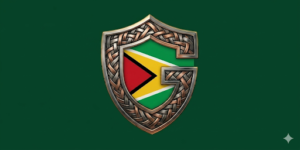
The Sovereignty of The Symbol

As Guyana approaches its 60th Independence Anniversary—our Diamond Jubilee—the branding we choose is more than just “art.” It is a statement of who we are.
The preliminary logo currently in circulation has sparked a necessary conversation, first highlighted by observers like Village Voice. To the forensic eye, the parallels are undeniable: the specific saffron hue and the 24-spoke navy wheel mirror the national symbols of India.
While we honor our ancestral roots and global ties, a Jubilee is a celebration of the home we built here, on this soil. In 1966, the Forbes Burnham government and the founders of our Republic established the Golden Arrowhead as a sacred contract. It was designed to be a singular, unifying aesthetic for a plural society—red for zeal, gold for wealth, and green for our vast land.
When national branding drifts toward the iconography of another sovereign state, we risk diluting our own unique “Guyanese-ness.” For a milestone as heavy as sixty years, our symbols must be a mirror where every Guyanese—of every descent—sees themselves reflected without explanation or defense.
As a voice of Indian descent writing from a purely nationalist prism, I believe we must guard the integrity of our sovereign identity. We are not a footnote in another nation’s history; we are a “One People” success story sixty years in the making.
Is this logo a “test fire” of a new direction, or a departure from the foundation of 1966? A national symbol should unite, not divide. We call for a return to the colors that define us all: the Red, the Gold, and the Green.
𝑻𝒉𝒆 592 𝑮𝒖𝒂𝒓𝒅𝒊𝒂𝒏 𝒘𝒂𝒏𝒕𝒔 𝒕𝒐 𝒌𝒏𝒐𝒘: 𝑫𝒐𝒆𝒔 𝒕𝒉𝒊𝒔 𝒍𝒐𝒈𝒐 𝒓𝒆𝒑𝒓𝒆𝒔𝒆𝒏𝒕 𝒀𝑶𝑼? 𝑶𝒓 𝒊𝒔 𝒊𝒕 𝒕𝒊𝒎𝒆 𝒕𝒐 𝒓𝒆𝒕𝒖𝒓𝒏 𝒕𝒐 𝒕𝒉𝒆 𝑨𝒓𝒓𝒐𝒘𝒉𝒆𝒂𝒅?

Transactional Diplomacy and the Courage to See Opportunity in Adversity

In an era when transactional diplomacy has become the global norm, Guyana must respond not with indignation or insularity, but with pragmatism, foresight, and the courage to see opportunity in adversity. President Irfaan Ali’s formal protest against Suriname’s decision to impose fees on vessels using the Corentyne River has ignited fierce debate, not just between Georgetown and Paramaribo, but among business chambers and trade advocates across the country. Yet amid the noise, one truth is clear — Guyana’s private sector has once again failed the test of vision.
Every major chamber and business commission has rushed to condemn Suriname’s move as protectionist, a knee-jerk reaction that reveals more about their own lack of imagination than any policy flaw across the border. True entrepreneurs understand that obstruction breeds innovation; real opportunity often hides where others see crisis. Adversity has always been the cradle of invention — but Guyana’s business elite appear more inclined toward complaint than creativity.
Let us not forget that “choke points” — those strategic intersections of trade, geography, and influence — have become the modern vocabulary of economic power. From Singapore to Panama, nations have turned location into leverage, converting geography into sustained prosperity. Ironically, while many Guyanese business leaders parrot Singapore’s success story, few seem to grasp the essence of that transformation. Singapore had no oil wells or forests to sell — only an unyielding supply of political will. Today, Suriname is demonstrating a similar temperament, employing its natural geography to create long-term fiscal gain. Why should Guyana begrudge such sovereign pragmatism?
Even more troubling is the hypocrisy underlying the local outrage. The same voices that decry Suriname’s assertion of sovereignty have remained curiously silent about Guyana’s own surrender of it — most glaringly in the oil sector. Our government, perched on a mountain of potential revenue, has timidly refused to implement a windfall tax, surrendering the nation’s fiscal destiny to ExxonMobil. The nation’s “captured state” has become an open secret, and yet the same business elites — who howl at Suriname’s tolls — have nothing to say about the most lopsided contract in modern times.
This duplicity must be called out, not just in political halls, but within the ethos and logos that define The 592 Guardian. Guyana’s future depends on leaders — both public and private — who can see beyond their limitations, who understand that sovereignty, economic innovation, and transactional diplomacy are not adversaries but allies. When protectionism meets pragmatism, we must choose courage over comfort. That is the real lesson in this moment — and the test of our national maturity.

𝐖𝐡𝐨𝐬𝐞 𝐕𝐢𝐬𝐢𝐨𝐧? 𝐓𝐡𝐞 𝐓𝐫𝐮𝐭𝐡 𝐁𝐞𝐡𝐢𝐧𝐝 𝐭𝐡𝐞 $𝟏𝟐𝐌 “𝐅𝐫𝐢𝐞𝐧𝐝𝐬𝐡𝐢𝐩” 𝐏𝐚𝐫𝐤 𝐓𝐡𝐞 𝐏𝐫𝐨𝐩𝐚𝐠𝐚𝐧𝐝𝐚 𝐋𝐨𝐨𝐩

Last evening, the nation was treated to the familiar spectacle of state-aligned media cameras capturing “progress.” The headlines spoke of a “government commitment to recreation” and a “presidential vision for regional development.” But as is often the case with the current administration, the narrative is built on the erasure of two critical truths: who actually gave the land and who actually paid for the work.
𝐓𝐡𝐞 𝐄𝐫𝐚𝐬𝐮𝐫𝐞 𝐨𝐟 𝐉𝐨𝐞 𝐕𝐢𝐞𝐢𝐫𝐚
The public is being subtly conditioned to view this as a government-built project. However, the foundation of this park was not a government initiative; it was a personal sacrifice.
• The Reality: The land—formerly part of Plantation Meer Zorgen—was a gift to the people of Guyana by Mr. Joseph Rudolph Vieira, AA (1920–2005).
• The Distortion: By rebranding the space as the “Guyana-China Friendship Park” and emphasizing “Government oversight,” the state media is effectively burying the legacy of a private citizen who donated his property for the public good long before the current political era.
𝐓𝐡𝐞 $𝟏𝟐 𝐌𝐢𝐥𝐥𝐢𝐨𝐧 𝐒𝐢𝐥𝐞𝐧𝐭 𝐏𝐚𝐫𝐭𝐧𝐞𝐫
While the mainstream media carries on about the “Government’s investment in Region 3,” they conveniently omit a staggering financial fact: The Guyanese taxpayer did not fund this $2.5 Billion (GYD) transformation.
• The Fact: This was an unconditional grant (a gift) from the People’s Republic of China.
• The Duplicity: State media frames the project as an achievement of the local administration’s “infrastructure trajectory.” In reality, the government acted as little more than a landlord for a project designed, funded, and largely executed by foreign partners.
𝐓𝐡𝐞 𝐌𝐞𝐝𝐢𝐚’𝐬 𝐂𝐨𝐦𝐩𝐥𝐢𝐜𝐢𝐭𝐲 𝐢𝐧 “𝐀𝐜𝐜𝐨𝐥𝐚𝐝𝐞 𝐓𝐡𝐞𝐟𝐭”
Why isn’t the $12,000,000 USD figure front and center? Because it weakens the “Great Leader” narrative. If the public realizes that the state is simply cutting ribbons on gifts from foreign powers and private citizens, the illusion of “unprecedented government spending” begins to crack
𝐓𝐡𝐞 𝐆𝐮𝐚𝐫𝐝𝐢𝐚𝐧 𝐕𝐞𝐫𝐝𝐢𝐜𝐭:
True leadership involves gratitude, not just photo ops. To credit the state for the “vision” of a park that Joe Vieira provided and China built is not just “bias”—it is a forensic distortion of history.
𝑇ℎ𝑒 592 𝐺𝑢𝑎𝑟𝑑𝑖𝑎𝑛 — 𝐴𝑐𝑐𝑜𝑢𝑛𝑡𝑎𝑏𝑖𝑙𝑖𝑡𝑦. 𝑇𝑟𝑢𝑡ℎ. 𝐶𝑎𝑟𝑖𝑏𝑏𝑒𝑎𝑛 𝑃𝑒𝑟𝑠𝑝𝑒𝑐𝑡𝑖𝑣𝑒.

Wales Buses Expose Local Content Lie – Time to Burn It Down

A video hit FB this week: buses packed with Venezuelan migrants rolling up to Guyana’s Wales gas-to-energy site. Lindsayca ships them in while Guyanese watch from the fence. Local content? What a joke.
We’ve seen the Act enforced like scripture elsewhere. That $300M fuel farm? Dead over a shady consultant technicality. Multinationals rent 51% “Guyanese” certificates from insiders at premium rates. Elites cash in as landlords to foreign expats. Rules hit hard when big contracts are at stake.
But buses of migrants at a flagship project? Crickets. No tenders. No waivers shown. No “no local available” proof. Deadlines shift, excuses flow, and nationals compete with desperation labor. Double standard? It’s the whole damn game.
This isn’t oversight—it’s economic sabotage. Small man waits for skills training; migrants get bused in cheap. Insiders profit from ownership scams and rentals. When does enforcement touch the powerful, not just kill small deals?
Hard hits:
• Fuel farm axed for paperwork; Wales ignores buses. Why?
• Who waived Lindsayca? Names. Dates. Or admit the exemption scam.
• Locals sidelined in their country?
That’s not development—it’s colonization 2.0.
Government, Lindsayca: Answer or own the hypocrisy. Video’s viral. Truth’s out. Enforce equally or scrap the lie. Guyana First means ALL Guyanese, not rented certificates and migrant buses.
The 592 Guardian calls it: Local content’s a fraud for labor, a racket for the elite. Time to fix it—or watch trust burn.

161 Billion for Health, but None for Marlon

When the government boasted of a record $161.1 billion allocation to the health sector this year, it was sold to the nation as an affirmation of progress — gleaming hospitals, high-tech diagnostics, and a promise that “all Guyanese” would benefit from improved healthcare delivery. Yet, as a nation, we stand today in collective mourning.
Twelve-year-old Marlon Jupiter is dead — gone before his time — because the state that swore to protect him could not find $7 million to save his life.
Marlon suffered from T-lymphoblastic lymphoma, a rare but treatable cancer. The care he needed did not exist in Guyana. His family, like so many others before them, turned to the public with desperation — social media pleas, bake sales, and appeals for help. While they struggled to raise US$35,000, the government was signing off on hundreds of millions in discretionary allocations: $900 million for “Men on a Mission,” $300 million for the Office of the President, and untold sums for lavish conferences, diplomatic missions, and “consultations.”
In a budget where individual kickbacks can exceed $7 million, it is a national disgrace that a child was forced to die for want of that same amount.
What value do mounds of concrete and air-conditioned wards carry when life-saving treatment remains beyond reach? Of what use are billion-dollar budgets when their impact cannot be measured in the preservation of a single innocent life? This country continues to exhibit a pathology of misaligned priorities — where optics eclipse substance, where monuments matter more than lives, and where political showpieces are dressed up as “investments in health.”
When “healthcare” is invoked to justify building promenades for private hospitals and expanding vanity projects under the First Lady’s fund, we see what truly drives the expenditure: image management, not human welfare. The Constitution guarantees free healthcare, but “free” means nothing when it is hollow — when fundamental care is missing, and when bureaucracy and neglect replace compassion and responsiveness.
Marlon’s death is not just a tragedy. It is an indictment. It represents criminal negligence by a state that failed to deploy its resources toward their constitutional purpose — the preservation of life.
Every public dollar misused or hoarded for politics is a moral crime, costing lives like Marlon’s. A government’s greatness is not measured by how many hospitals it builds but by how many lives its health system can save — in real time, when help is needed most.
Rest easy, young Marlon. You deserved better.
And to those in power: your legacy will be judged not by the floodlights on new infrastructure, but by the number of children who lived to see adulthood because you chose compassion over vanity.