The Billion-Dollar Drainage Paradox
Billions Vanished; Floodwaters Return — The D&I Accountability Gap They Can’t Spin Away
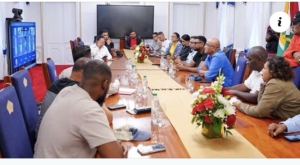
The May 31 CHRONICLE– CROSSFIRE column titled “Floodwaters and Political Opportunism” is an audacious attempt to repackage a decade of administrative failure as leadership. The column praises President Irfaan Ali for convening emergency meetings “before dawn” and deploying pumps as if this were a triumph. However, this is not leadership—it is damage control for a system that should already be functioning effectively after $ 140 billion in spending.
The fundamental question the column dodges is this: if billions have truly been spent on drainage and irrigation (D&I), why does the nation revert to crisis mode with every heavy rainfall?
Let’s examine the actual numbers:
| Spending Category |
Amount (GYD) |
Timeframe |
Documented Outcome |
| Total D&I allocated (government claim)
|
|
|
|
|
G$140 billion |
2020–2026 |
Flooding persists nationwide |
| D&I expended by mid-2024 |
G$14.8 billion |
2020–mid-2024 |
G$14.8B spent but systems still fail |
| 2024 D&I budget allocation |
G$72.3 billion |
Single year |
Floods continued throughout 2024–2026 |
| 40 mobile pumps purchase |
G$29.4 billion |
2024 |
Still deploying pumps in May 2026 |
| Linden (Region 10) D&I projects (4 years) |
G$1.5 billion |
2020–2024 |
Region 10 still flooded March 2026 |
| Liliendaal pump station |
G$1.054 billion |
Completed 2025 |
Georgetown still flooded December 2025 |
| CDC disaster response allocation |
G$73 billion (~US$350M) |
2026 |
Victims report NO relief received |
| 2022 flood protection (sea/river defenses) |
G$5 billion |
G$5 billion |
Flooding returned 2023, 2024, 2025, 2026 |
| Region Two D&I works |
G$2.4 billion |
2024 |
Ongoing—not completed; still flooding [29] |
| Region Six D&I modernization |
G$7 billion |
2024 |
Still under construction, not operational |
| 2024 supplementary flood relief |
G$10 billion |
2026 |
Aid to 30,000 households—emergency only |
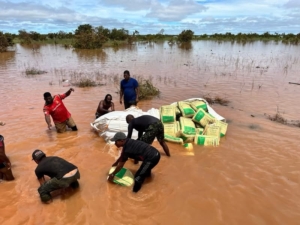
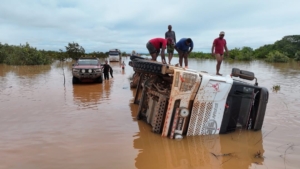
These are not marginal investments. This is transformative-level spending that should have permanently resolved coastal flooding. Yet the flooding persists with devastating regularity.
Investigative Findings: Projects Announced, Promises Broken
The column breathlessly describes “hundreds of pumps operating across the country” and “newly acquired mobile systems.” But the investigative record tells a different story:
1. Geographic Spread of Failure (May 2026)
•East Coast Demerara: ~100mm rainfall, flooding in most communities
•Leonora (Region 3): ~225mm rainfall, severe flooding
•Region 10 (Linden): Repeated flooding despite G$1.5B in D&I spending
•Berbice: Communities flooded simultaneously
•West Coast: Also affected, showing systemic failure
When flooding hits five regions simultaneously, this is not an “unpredictable weather event.” This is systemic infrastructure collapse.
2. The December 2025 Georgetown Flooding Contradiction
In December 2025, downtown Georgetown flooded after “only a brief period of rain,” paralyzing commerce and schools. This occurred just months after:
•President Ali boasted of “electronic monitoring of the drainage system by October 2025”
•Minister Mustapha announced billion-dollar drainage investments
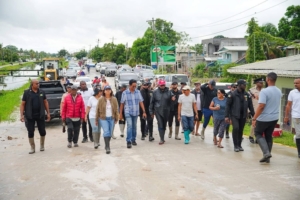
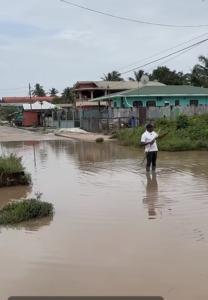
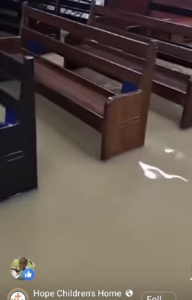
The result? Knee-high water in commercial streets, children removing shoes to walk to school, and businesses forced to close.
3. The G$73 Billion CDC Reliefs Failure
Despite G$73 billion (~US$350 million) allocated to the Civil Defense Commission for disaster preparedness and response:
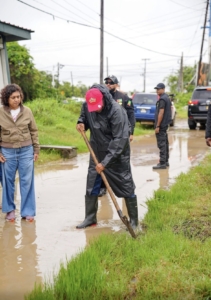
•Residents report receiving NO cleaning supplies (mops, bleach)
•No financial aid distributed
•No emergency support provided
•Families “deadlifting refrigerators out of contaminated floodwater” in the dark
This is not “swift activation.” This is procurement paralysis at the expense of suffering citizens.
4. The 30,000-Household Emergency Pattern
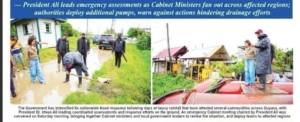
The government distributed almost 30,000 hampers to flood victims in May 2026. This mirrors the 2021 flood crisis when 29,300 households in 300+ communities were affected. The pattern is clear:
•Flood → Emergency hampers → Water recedes → Families rebuild → Flood returns → Repeat
This is not governance. This is crisis management as a permanent state.
The Root Problem: Corruption, Cronyism, and Administrative Incompetence
The column dismisses criticism as “political theatre” and “manufactured outrage.” But the real crisis is documented in investigative reports:
1. Corruption at the Core of Infrastructure Failure
Shadow Attorney General Roysdale Forde explicitly states that Guyana’s infrastructure crisis is rooted in systematic corruption:
“Billions in public funds allocated for infrastructure projects have been misused or siphoned off, with political patronage and corruption at the forefront… contracts are routinely awarded to party loyalists, many of whom lack the competence to execute the work but are skilled in enriching themselves at the public’s expense.”
Forde goes further
“It is the result of political decisions driven by kickbacks, favoritism, and outright theft… widespread corruption has led to shoddy construction, overpriced repairs, and the creation of ‘ghost’ projects that serve only to line the pockets of those in power.”
2. The PPP/C Cronyism Network
Investigative reports document that up to 70% of contracts in some regions go to cronies through blatant favoritism. Businesses are routinely pressured to pay kickbacks of 10–20% of contract values just to secure deals.
3. The Heroes Highway Example
U.S. Secretary of State Marco Rubio personally experienced the Heroes Highway during his March 2027 visit and called it “dangerous,” accusing contractors of doing a “terrible job”:
“If you did that job in America, someone would sue you for a lot of money… You’re better off with the dirt road… If you’re going to build a road, build a real road.”
The highway was built by 12 local contractors with close ties to the ruling PPP/C. This is not accidental poor quality—this is systematic patronage.
4. The Kingston Waterfront Scandal
The Kingston Waterfront development project, launched as a “transformative urban renewal initiative,” has come under scrutiny for massive cost overruns and lack of accountability:
“Investigations have revealed irregularities in the bidding process, with a handful of well-connected contractors linked to PPP/C officials allegedly receiving inflated contracts.”
5. Oil-for-Infrastructure Deals Under Scrutiny
Investigative reports suggest that “Oil for infrastructure” deals are rife with corruption:
“Key government figures are accused of receiving kickbacks from foreign firms contracted to undertake these projects, inflating costs and delivering subpar results while siphoning off public funds.”
The Auditor General’s Flood Relief Investigation
In 2022, the Auditor General launched a special investigation into the Government’s Flood Relief Program after discovering major discrepancies:
•Office of the Prime Minister received G$183.5 million for ‘Other expenses’
•G$10 billion supplementary budget approved for Disaster Preparedness, Response, and Management
•Total revised allotment: G$10.184 billion
•Hundreds of millions unaccounted for.
The Auditor General’s report explicitly flagged major discrepancies in how flood relief funds were spent. This is not speculation—this is official audit findings.
The “Swift Response” Myth Deconstructed
The column describes the government response as “swift activation” and “coordinated response.” Let’s examine that claim:
What the Column Claims:
• “President convened senior officials before dawn”
• “Pumps were deployed, drainage systems mobilized”
• “More than 200 pumping units were deployed nationally”
• “Dozens of pumps were already operational on East Coast Demerara”
What Actually Happened:
•President had to convene emergency meetings at sunrise because the system failed
•200 pumping units deployed as emergency stopgaps, not as functional infrastructure
•30,000 households received emergency hampers, not systemic relief
•G$73 billion CDC allocation yielded no visible mobilization for victims
Here’s the contradiction: If the system was already “fixed” with G$140 billion in spending, why does the President need to convene emergency meetings every time it rains?
The answer is simple: The infrastructure was not fixed. The money was wasted.
The Real Question: Why Does the President Still Have to Fix What Was Already Supposed to Be Fixed?
The column frames the President’s sunrise emergency convening as “leadership.” But this is the leadership of a lighthouse keeper who lights the lamp every night instead of fixing the broken bulb during the day.
A properly functioning D&I system would:
•Drain water naturally without emergency pump deployment
•Prevent floodwaters from entering homes, yards, and business
•Operate without requiring Presidential emergency meetings
•Not require 30,000 households to receive emergency hampers
The fact that the President must convene senior officials, including Vice-President Bharrat Jagdeo, ministers, regional leaders, and engineers every time it rains heavily is evidence of systemic failure, not leadership.
Why Criticism Is Not “Opportunism” — It’s Accountability
The column attempts to delegitimize dissent by calling it “political theatre,” “calculated exploitation,” and “livestream outrage.” But citizens are not “manufacturing” this crisis. They are living it:
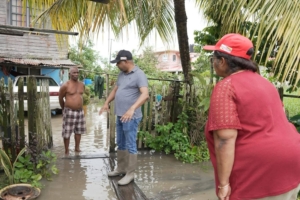
•Families in flooded homes with water “right with the bed”
•Small businesses destroyed, livelihoods disrupted
•Schoolchildren removing shoes to walk through floodwaters
•Entire regions facing simultaneous flooding
•30,000 households receiving emergency hampers instead of permanent solutions.
This frustration is not political theater—it is accumulated anger from a decade of repeated flooding, broken promises, and unaccounted spending.
The Historical Context: This Is Not New
The column gestures at “historical perspective” and claims “recent responses demonstrate a level of capacity and coordination that would have been difficult to imagine in previous decades.” But the data contradicts this:
2005 Floods: Nationwide catastrophe, weeks of flooding
2013 Floods: 30,000+ households affected
2021 Floods: 29,300 households in 300+ communities affected
2025 Floods: Georgetown downtown paralyzed after brief rain
2026 Floods: Multiple regions simultaneously flooded, 30,000 households receiving hampers
The pattern is clear: Flooding recurs with increasing regularity, not decreasing frequency. The column’s claim of “improved capacity” is contradicted by the facts.
What the Public Is No Longer Buying
The column’s attempt to frame emergency response as success and criticism as opportunism is a political misfire. No serious observer doubts that emergency response is necessary. But response is not a substitute for competence, prevention, and accountability.
Guyanese are not buying the narrative that:
| Claim |
Reality |
| G$140 billion in D&I spending is “working” |
Flooding persists annually, worse each year |
| President convening emergency meetings is “leadership” |
It’s failure of preparedness requiring Presidential intervention |
| Critics are “opportunists” |
They’re citizens demanding answers for recurring disaster |
| “Swift activation” proves competence |
Emergency pumps = stopgap for broken infrastructure |
| CDC “mobilized” with G$73B |
Victims report NO relief received |
| “Dozens of pumps operational” |
200 pumps deployed as emergency stopgap |
| “Future investments required” |
It’s failure of preparedness requiring Presidential intervention |
G$140 billion already spent—WHERE DID IT GO?
The Questions That Must Be Answered
The floodwaters will recede. But these questions remain:
1.Where did the G$140 billion go? If systems were properly built, why does flooding persist?
2.Why did the G$73 billion CDC allocation yield no relief for victims? Who authorized this spending?
3.Why are contracts routinely awarded to PPP/C loyalists without competitive bidding?
4.Why do 70% of contracts in some regions go to cronies?
5.Why did the Auditor General find hundreds of millions unaccounted for in flood relief?
6.Why does the President still convene emergency meetings every time it rains?
7.Why did Georgetown flood in December 2025 after “electronic monitoring” was supposedly implemented?
8.Why are roads like Heroes Highway called “dangerous” by the U.S. Secretary of State?
Conclusion: The Public Has Seen This Script Before
The column’s rhetoric is familiar: praise emergency response, dismiss criticism, deflect from systemic failure. But the public is no longer buying it.
Guyana deserves more than narratives of reassurance. It deserves:
•Transparency on what is not working
•Accountability for why billions were wasted
•A credible plan to ensure the next rainfall event does not produce the same national distress
Until those questions are answered with honesty and measurable results—not rhetoric—the public will rightly reject any attempt to reclassify recurring disaster as governance success.
Politics at its worst is profiting from problems. Politics at its best solves them. This government has yet to prove it can do the latter after G$140 billion in spending.
The floodwaters will recede. What remains will be a clearer picture of who squandered the money, who failed to build the systems, and who is responsible for the suffering of 30,000 households.
History has a habit of distinguishing between the two. And voters usually do as well
⁂EDITOR NOTE’S
Analysis of NDIA maintenance failures cited in recent audit reports
The recent Auditor General report on NDIA is quite clear: the problem is not simply “bad weather,” but a pattern of weak planning, poor records, vacant leadership posts, and incomplete maintenance oversight that undermines drainage performance. NDIA spent G$6.674 billion on asset maintenance from January 2021 to June 2024, yet the audit still found no structured maintenance system, no comprehensive planning, and no reliable way to verify nearly half of sampled expenditure.
What the audit found
The audit says NDIA had over 30 vacancies every year from 2021 to 2024, with key positions such as CEO, Deputy CEO, Corporate Secretary/Legal Officer, Manager of Operations and Maintenance, Mechanical Engineers, Internal Auditor, and Engineering Technicians still vacant by September 2024. It also found that the Authority could not present its asset management policy, could not support claims about a multi-year strategic plan, and had no assessed training needs or training plan for staff. Those are not minor administrative gaps; they are the kind of failures that weaken daily upkeep and make systems break down when heavy rain arrives.
Maintenance spending gap
The report shows maintenance spending rising sharply: G$1.079 billion in 2021, G$1.643 billion in 2022, G$2.461 billion in 2023, and G$1.490 billion in the first half of 2024, totaling G$6.674 billion. But the audit also says NDIA’s budget documents did not explain how maintenance needs were calculated, and financial reports were too vague to show what was spent on which maintenance category. In one sample review of 99 assets costing G$2.314 billion, NDIA could present vouchers for only G$1.126 billion, leaving G$1.188 billion, or 51 percent, unverified.
Recordkeeping failures
The audit is especially strong on asset control and documentation. It found the asset register missing key details such as asset location, serial numbers, identification numbers, and transfer records, which meant the register could not reliably track equipment. It also found that proof of ownership for most of the more than 500 recorded assets was not provided, and that 10 pieces of heavy-duty equipment, motor vehicles, and cycles seen in the field were not recorded in the register. That kind of record failure makes it much easier for assets to be lost, misused, or simply left unaccounted for.
NDIA’s recent audit shows that billions were spent on drainage maintenance, but weak planning, vacant senior posts, poor asset records, and unverifiable expenditures left the system unable to deliver the reliability Guyanese communities were promised.