THE 24.8 MILLION QUESTION
THE 592 GUARDIAN • INVESTIGATIVE EDITORIAL
PUBLIC ACCOUNTABILITY SERIES
THE 24.8 MILLION QUESTION:
State-of-the-Art Rhetoric, Standard Passenger-Boat Reality
A detailed procurement query into the Ministry of Health’s water ambulance acquisition for Region 7 (Cuyuni-Mazaruni)
By: Hem Kumar
There is a particular kind of insult embedded in bureaucratic language—one that is the more offensive for being dressed in the vocabulary of good intentions. When the Ministry of Health of the Cooperative Republic of Guyana recently announced the handover of a new “water ambulance” to the Regional Democratic Council of Region 7 (Cuyuni-Mazaruni), the press release read like a triumph of modern governance. Words such as “state-of-the-art,” “highly connected regional network,” and “synchronous telemedicine” were deployed with the smooth confidence of officials who do not expect to be asked follow-up questions.
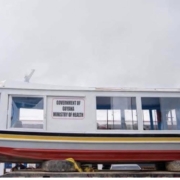
The public was not shown a technical specification sheet, a bill of quantities, or an independent surveyor’s assessment. The public was shown a photograph. And that photograph—circulated under the official banner of the Ministry itself—tells a story that is in direct, irreconcilable conflict with the text that accompanied it.
The sum involved is 24,883,154 Guyanese dollars. At the prevailing exchange rate of approximately 208 GYD to one United States dollar, that figure converts to USD 119,630—a figure that, rounded for public discussion, stands at one hundred and twenty thousand United States dollars. This is not a rounding error. This is not a procurement of modest ambition. This is an expenditure that, at international maritime commercial rates, should purchase a purpose-engineered emergency medical vessel equipped with professional-grade systems. What appears to have been delivered, based on the official photographic record, is something substantially less than that.
This editorial is not an attack on the aspiration. The residents of Region 7—scattered across one of Guyana’s most geographically challenging and medically underserved territories, navigating the treacherous rapids and volatile currents of the Middle and Lower Mazaruni River—deserve emergency medical transport of the highest standard. This editorial is a demand, made on their behalf and on behalf of every Guyanese taxpayer, for answers to questions that the official press release conspicuously failed to address.
I. THE VESSEL IN THE PHOTOGRAPH: WHAT THE OFFICIAL IMAGE REVEALS
The first and most fundamental tool of public accountability is the ability to compare an official claim against observable physical evidence. In this case, the Ministry itself has provided that evidence in the form of the handover photograph.
What does a genuine, purpose-built water ambulance look like at the USD 00,000–50,000 price point in international markets? It features a reinforced, high-freeboard hull specifically engineered for rough-water conditions; a wide transom or bow-loading door for horizontal stretcher access; enclosed, climate-regulated patient bay with minimum standing headroom of 6 feet for medical personnel; twin-engine propulsion for operational redundancy in emergencies; marine-grade satellite communications hardware; dedicated power inverters for medical equipment; and clearly delineated medical cross markings and emergency lighting arrays.
What does the official photograph reveal? A standard, low-clearance enclosed river commuter hull—a design template familiar to anyone who has taken a passenger launch on Guyana’s interior waterways—fitted with a single outboard engine, full-length commercial passenger windows, narrow side-entry doors, and what appears to be a standard low-profile roof. The vessel has been furnished with an official Ministry of Health sticker and a paint livery.
It is a legitimate and serviceable river craft. It is not, by any internationally recognized standard, a state-of-the-art water ambulance. And the difference between those two things is not cosmetic—it is the difference that determines whether a critically injured patient lives or dies during a midnight emergency evacuation on the Mazaruni.
II. SEVEN HARD QUESTIONS THE MINISTRY MUST ANSWER
The following questions are not rhetorical. They are the precise technical and financial interrogatories that any responsible parliamentary oversight body, any diligent Auditor General’s office, and any independent procurement review board should be placing before the Ministry of Health as a matter of urgency.
QUESTION 1: Where is the twin-engine redundancy—and who signed off on a single-engine configuration for emergency medical service?
The vessel visible in the official photograph is powered by a single outboard motor. In the conditions of Region 7’s river systems—known for their unpredictable currents, submerged rocks, and the operational reality that emergency calls do not arrive during calm daylight hours—a single engine is not a specification; it is a liability. International maritime safety standards for emergency medical vessels are unambiguous: redundant propulsion is not optional where human life depends on arrival.
If the original procurement tender specified twin-engine propulsion—as any competent specification for an emergency vessel in these waters should have—then the delivery of a single-engine vessel represents a direct failure of contract compliance. If the tender itself specified only a single engine, that failure occurred at the design stage and implicates whoever drafted the technical specifications. Either way, the public is owed a direct answer: what propulsion system was specified, what was delivered, and what was paid for?
QUESTION 2: How does a stretcher physically enter this vessel—and was patient loading ever tested before handover?
Emergency medical transport begins before the engine starts. It begins the moment paramedics attempt to load a patient. A trauma victim—a gunshot wound, a snakebite case going into shock, a woman in obstetric crisis, a child with a broken spine from a mining accident—cannot be bent, tilted, or squeezed through a narrow side door. Medical protocol for spinal and trauma cases mandates horizontal loading on a rigid stretcher.
A purpose-built water ambulance addresses this with a wide transom door at the stern, a bow-loading ramp, or a purpose-designed side hatch with sufficient clearance for a standard medical stretcher—typically 22 to 24 inches wide and 76 inches long. The vessel photographed shows a standard closed stern and conventional narrow side doors consistent with a passenger launch configuration. The Ministry is invited to demonstrate, on camera, with a stretcher and two crew members simulating an emergency load, precisely how this is achieved at 2:00 in the morning on a moving river. Until that demonstration is provided, the public is entitled to conclude that this fundamental operational requirement was never tested.
QUESTION 3: Can a medic stand upright inside this vessel—and if not, how is emergency clinical intervention performed?
The roof profile of the vessel in the photograph is consistent with standard river commuter construction, optimized for passenger capacity and fuel efficiency rather than clinical functionality. The interior headroom appears insufficient to allow a medical professional of average height to stand upright. This is not an aesthetic concern. CPR requires the practitioner to apply vertical, body-weight-assisted chest compressions from a standing position. IV bag administration requires the bag to hang above the patient. Airway management, wound packing, and defibrillation all require a medic who can move freely and with postural stability in a rocking vessel.
What is the interior standing headroom of this vessel at its tallest internal point? What is the specified minimum headroom in the original tender? Were these measurements verified at acceptance and handover? Was a medical officer present during the acceptance inspection to certify clinical operability?
QUESTION 4: What, precisely, does the “telemedicine” component consist of—and what does it cost as a line item?
The Ministry’s press release placed considerable emphasis on the vessel’s telemedicine capability, describing “synchronous” digital links to specialist physicians as a defining feature of this investment. Synchronous telemedicine—live two-way video consultation with a remote specialist—requires, at minimum: a marine-grade satellite internet terminal (such as a Starlink Marine or equivalent unit, retailing at USD 2 ,500– plus subscription @ $250 per month); a dedicated power inverter system rated for marine use; a ruggedized tablet or display with sufficient brightness for clinical use in sunlight; and a secure, encrypted communications platform.
The Ministry must produce the itemized bill of quantities that separates the vessel cost from the telemedicine hardware cost. If telemedicine hardware is not physically installed and operational on this vessel, then the word “telemedicine” in the press release is not a feature description—it is a misrepresentation used to justify a price point that the underlying asset does not support. The public requires a specific answer: what hardware is installed, who supplied it, at what cost, and can it be independently inspected and tested today?
QUESTION 5: Where is the patient privacy—and was medical dignity factored into the design at any stage?
The vessel in the photograph features large, fully transparent commercial glass windows running the length of the passenger cabin—standard construction for a commuter launch where the priority is natural light and passenger comfort. A medical transport vessel is not a commuter launch. A patient being evacuated from a mining injury, a sexual assault, an obstetric emergency, or a mental health crisis has a legal and ethical right to medical privacy. Exposure of vulnerable patients to the full view of bystanders, riverbank communities, and fellow travelers is not a minor operational inconvenience. In many jurisdictions, it constitutes a violation of patient rights.
Did the tender specification include privacy partitioning, opaque window film, or any other patient dignity provision? If so, has it been installed? If not, why was patient privacy omitted from a vessel whose sole stated purpose is medical transport?
QUESTION 6: What is the hull classification, and has it been certified for the specific hydraulic conditions of the Mazaruni River?
The Cuyuni-Mazaruni region is not a benign operating environment. The Mazaruni River is characterized by Class II–IV rapids in several stretches, shifting sandbanks, submerged debris, and seasonal flood conditions that can dramatically alter navigable channels within hours. A standard commuter passenger hull, optimized for calmer interior waterway conditions, is not automatically certified for rough-water emergency operations.
What is the hull’s certified operating classification? What is its rated maximum wave height and current speed tolerance? Was the hull design reviewed by a qualified marine architect for Region 7’s specific river conditions? Was a sea trial—or more precisely, a river trial under simulated emergency load conditions—conducted before the handover ceremony was organized and the press release written?
QUESTION 7: What is the full procurement audit trail—and who authorized the final payment?
Every public procurement in Guyana is governed by the Procurement Act and the regulations of the National Procurement and Tender Administration Board (NPTAB). The public is entitled to know: Was this contract subject to open competitive tendering or was it sole-sourced? If competitive, how many bids were received, and on what technical and financial basis was the winning bid selected? Was the evaluation committee comprised of qualified maritime and medical professionals, or administrative generalists? Was a technical inspection completed by an independent surveyor prior to handover? Who signed the acceptance certificate confirming delivery in conformance with specifications? Who in the Ministry hierarchy authorized final payment, and on what certification basis?
These are not hostile questions. They are the routine, minimum documentation that any transparent, accountable government procurement system generates as a matter of course. If the answers are clean, producing them costs nothing. The reluctance to produce them, should it arise, will itself constitute an answer.
III. THE COMPARATIVE VALUE ARGUMENT: WHAT 120,000 USD SHOULD BUY
To provide context that moves this debate beyond assertion, consider what USD 120,000 commands in the purpose-built emergency water vessel market. At that budget, international maritime suppliers—including regional manufacturers in Trinidad and Tobago, Brazil, and the United States—can deliver vessels including a rigid inflatable boat (RIB) ambulance configuration with twin 150HP outboards, full paramedic bay with 6.5-foot headroom, rear transom door, two-stretcher capacity, and integrated GPS/VHF/AIS systems; an aluminum-hull shallow-draft medical launch purpose-built for river rapids with twin-engine redundancy, privacy-screened patient bay, roof-mounted emergency lighting, and marine Starlink installation; or a purpose-built fiberglass catamaran hull for river ambulance service with increased stability in fast-water crossings, integrated telemedicine suite, and solar supplemental power.
These are not hypothetical luxury items. They are standard, commercially available emergency medical vessel configurations. The question the Ministry of Health cannot escape is this: if these options exist at or near this price point in the international market, why was the procurement process unable to secure any of them? Was the market properly surveyed? Were international suppliers invited to tender? Was the specification written to invite genuine competition, or written around a predetermined supplier and a predetermined product?
IV. THE PATTERN THIS PROCUREMENT FITS
This editorial would be incomplete without acknowledging the wider context in which this procurement must be read. Guyanese civil society and the independent press have, over successive administrations, documented a pattern in which public sector infrastructure procurement—particularly for remote and hinterland communities where oversight is logistically difficult and community voices are least amplified—produces a recurring formula: premium price, bureaucratic fanfare, and sub-standard physical delivery.
Region 7 communities are not in a position to easily inspect or challenge what is delivered to them. Their geographic isolation—the very isolation that makes a proper water ambulance so critical—also makes them among the most vulnerable communities to procurement that prioritizes appearances over function. The Ministry of Health, which has a specific mandate to protect the health and lives of all Guyanese citizens regardless of geography, bears a heightened duty of care toward these communities, not a reduced one.
The framing of a standard river craft as “state-of-the-art” is, in this context, not merely a matter of imprecise language. It is the deployment of sophisticated rhetoric to manage the perceptions of an urban public that will likely never see the vessel—while the rural communities who will depend on it for their lives are left with something materially different from what they were promised and what their taxes paid for.
V. WHAT ACCOUNTABILITY REQUIRES
The 592 Guardian calls on the following institutions to act, without delay:
- The Auditor General’s Office should initiate an immediate procurement audit of this contract, demanding the original tender documents, technical specification sheets, bid evaluation reports, supplier invoices, acceptance certificates, and all payment authorizations.
- The Parliamentary Sectoral Committee on Social Services should summon the Permanent Secretary of the Ministry of Health and the relevant Procurement Officers to provide testimony on the procurement process, the selection criteria, and the acceptance procedure.
- The National Procurement and Tender Administration Board should review whether the procurement methodology and supplier selection conformed to the letter and spirit of the Procurement Act.
- The Ministry of Health should, as a gesture of transparency and public confidence, invite an independent maritime surveyor and a registered medical officer to conduct a joint technical inspection of this vessel and publish their findings in full.
- Civil society organizations and the legal fraternity are invited to consider whether the citizens of Region 7 have a cognizable public interest action arising from the delivery of an asset that may not conform to the specifications for which public funds were expended.
Somewhere in Region 7, tonight and every night, a community health worker is hoping that the next emergency—the mining accident, the difficult birth, the snakebite case—arrives during daylight hours, in calm water, with a stable patient who can be carefully positioned in a narrow side-entry door. They are hoping because hope, at this moment, is what the 24.8 million has left them.
The public is not asking for perfection. The public is asking for honesty—and for a government that understands the difference between a press release and a pulse.
THE 592 GUARDIAN • INVESTIGATIVE EDITORIAL
The 592 Guardian is committed to public interest journalism. Corrections or official responses from the Ministry of Health are welcomed and will be published in full.